Startups, mid-sized firms would be hit hardest by H-1B fee hike, experts say
The U.S. recently announced plans to raise H-1B visa fees to $100,000. Experts say the increase could impact America’s edge in science and technology.

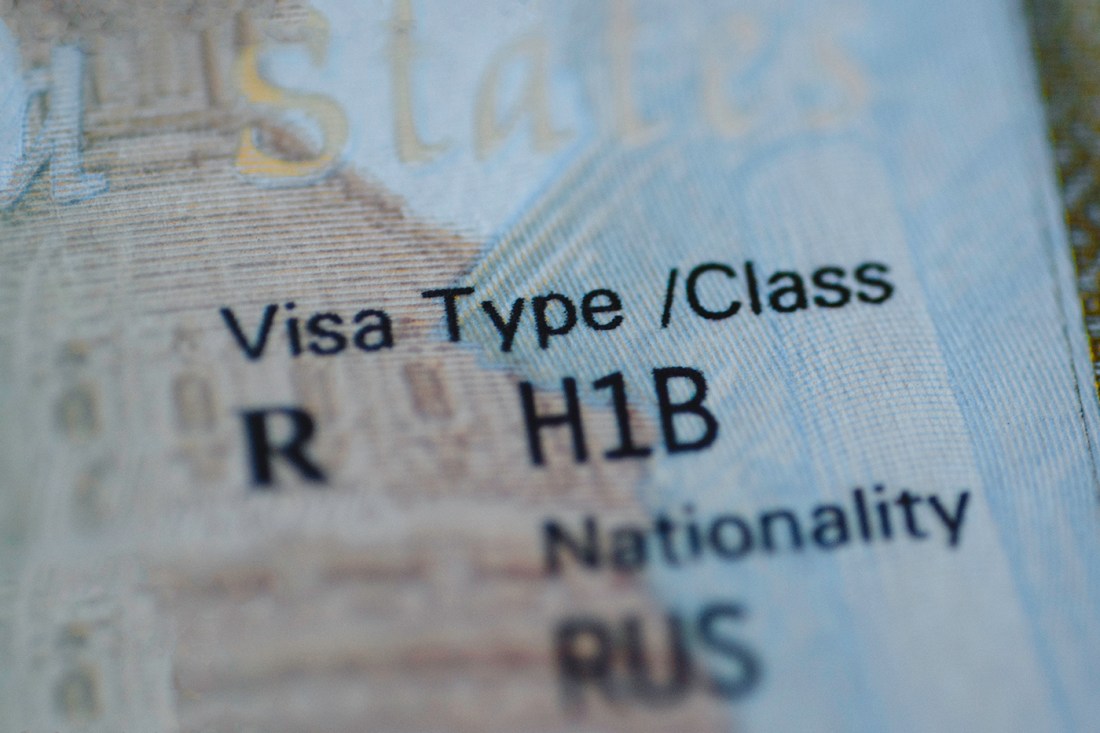
H-1B visas have helped launch the careers of high-profile entrepreneurs and CEOs such as Elon Musk (Tesla), Sundar Pichai (Google), Andrew Ng (DeepLearning.AI, Google Brain) and Eric Yuan (Zoom).
The Trump administration recently announced a sweeping change to the visa program, increasing the fee for new H-1B petitions to $100,000.
The move raises questions about the future of the U.S. tech industry, which has long relied on highly skilled foreign-born talent.
Startups and mid-sized firms would be hit hardest, say Northeastern University experts, while giants like Amazon and Google might absorb costs or shift jobs abroad.
The H-1B holders fill specialized STEM roles where U.S. shortages persist. The policy could hurt U.S. competitiveness and weaken the country’s global edge in science and technology, they say.
“It’s hard to know what the objectives of the administration are,” says Mindy Marks, an associate professor of economics at Northeastern University.
A program rooted in shortages
Congress created the H-1B program in 1990 to allow U.S. employers to temporarily hire foreign workers in “specialty occupations” requiring highly specialized knowledge and at least a bachelor’s degree. The program recognized that U.S. innovation, including the invention of the internet and the World Wide Web, was outpacing the domestic supply of STEM workers, says Annique Un, Northeastern associate professor of international business and strategy.
“It would be great if we could source them domestically. But we do have a shortage,” Un says of those workers.
Congress capped new H-1B visas at 85,000 annually, with 20,000 reserved for advanced degree holders. Since demand for these visas usually exceeds the cap, they are distributed by lottery.
However, there are cap-exempt institutions that receive thousands of additional approvals each year. For example, about 400,000 applications were approved in 2024; 65% were visa renewals and 141,207 were new hires.
H-1B holders account for about 730,000 jobs — a small fraction of the 170 million civilian labor force and 36.8 million STEM jobs.
Foreign-born employees made up nearly 19% of the U.S. STEM workforce in 2021, according to the National Science Foundation, including citizens and non-citizens. But their share is dramatically higher at the doctoral level — 58% for computer and mathematical scientists and 56% for engineers.
In 2022, only 38% of American adults had a college degree, according to the U.S. Census Bureau. Those with advanced degrees mostly pursued doctoral degrees in non-STEM fields, Un says, while countries like India and China continue to funnel large numbers of students into technical disciplines.
India dominates the H-1B pipeline: in 2024, 71% of approved applicants were Indian nationals, followed by China at 12%.
A six-figure fee
Until now, H-1B visa fees were well below $10,000.
The new six-figure fee, Marks says, is arbitrary. She expects the overall number of visas to fall, leaving the market to determine which firms value foreign talent most.
If approved by Congress, Un says, the change will hit startups and mid-sized companies the hardest. Giants like Amazon, IBM, Microsoft, Google or Meta may absorb the cost.
“Especially if Americans don’t want to go to the regions of the country that need STEM workers,” she says.
Some foreign workers are willing to start in less popular areas such as Mississippi or South Carolina, she says, and apply for a green card sponsored by their employer later.
Editor’s Picks





Larger corporations might also sidestep the fee by hiring through their foreign subsidiaries and using L visas for intracompany transfers, or by simply keeping jobs abroad.
Who will bear the cost?
Economic theory suggests, Marks says, the new fee will be split between employers and workers. Some companies may offset costs by lowering salaries.
“How much of the cost gets split between the two parties depends on their elasticities,” she says. “It depends on how substitutable the immigrant worker is for a native worker.”
If native workers are available, foreign wages might fall by as much as $100,000. If not, companies may absorb the expense to secure the best talent.
Can the U.S. replace foreign workers?
Efforts to grow the domestic STEM pipeline — from high school internships to programs for girls in STEM — are underway, Un says, but the shortage persists.
“These are people working in very specialized areas, whom the company has deemed as the best fit for the job,” Marks says. “It would be like trying to staff a professional sports team and saying, ‘Well, yes, but you’re not allowed to have any athletes who were born in other countries.’ Your team will not be as good.”
The government can incentivize companies to ramp up training and apprentice programs, she says, and young people to pursue careers in STEM. But this solution takes time and may be short-lived if demand for certain technical skills shifts. In those cases, it makes more sense to rely temporarily on global talent.
H-1B holders also bring economic benefits. They have relatively high salaries and pay relatively high tax rates. The U.S. government doesn’t have to spend any money on their education. They also make Social Security contributions that they most likely won’t end up collecting.
“They pay more taxes than the government has to spend providing them services,” Marks says.
Studies have shown that U.S. foreign-born residents invent more products and register more patents, publish more research papers and are more likely to start new companies.
Foreign-born workers also boost team productivity, Marks says, bringing new ways of thinking, diversity training and cultural awareness, which can be critical when U.S. companies expand abroad.
Potential downsides
Credible studies show, Marks says, that because H-1B workers are tied to one employer, companies often have leverage to pay them less than native workers.
“That is part of the reason companies like to hire them,” Marks says.
Shortage of high-skilled foreign workers might raise wages for the U.S. residents in the short run, she says, but in the long run, companies are likely to figure out different solutions, like relocating jobs overseas. The U.S. will end up losing any additional jobs, like administrators and janitors related to the business.
A decline in international students who often see H-1B as a path to stay in the U.S. could also hurt American higher education revenues and jobs.
What is behind these changes?
Some speculate the administration may prefer attracting European workers over Indian or Chinese nationals. But Un doubts this strategy would work: Europeans can already move within the EU, where health care access and retirement benefits are strong.
Others say the policy could be a leverage in trade negotiations with India. Indian corporations like Tata Consultancy Services and Infosys rely heavily on H-1B visas. But, Un says, it is unlikely that this would push India to make concessions.
“It’s a source of pride, and also India has a trade deficit in services with the U.S., although it enjoys a trade surplus in merchandise,” she says.


